Total Pageviews

Friday, May 6, 2011

Testing of ideas in the woods

In collaboration with the workshop in the local prison in Kongsvinger, the second model was made.

To test the ideas I invited a small group of people to actively participate to use the ´Seat with a view´ and to reflect upon the experience of it afterwards.


The first test to make sure it was safe, was done by me, then after the ´security-check´ the little group of people tested it out.


The experience of using it, led to playful reactions and people were pulled out of their own comfortzones and invited to action and reflection. Some people used it as a help-device to climb even further up into the tree, other started pretending to be a bird in the tree and said it made them feel free.


Preparing for photodocumentation and testing of ideas in the woods

Monday, February 7, 2011

´Family of chairs´ an exploration with discarded furniture

One day a familily of discarded chairs knocked at my door. They all had different problems: wear and tear, missing seats etc. I invited them in and started playing, rearranging and new images started emerging.


´Seat with a View´is produced in co-operation with Kongsvinger Fengsel

The second version of ´Seat with a view´ is now ready to pick up at the local prison. I made the first version myself and now the next version is ready for testing out.


If you want the rainbow, you have to put up with the rain

I am interested in looking at the tiny little happenings and rituals in everyday life. 

How can I tranform these tiny little happenings and daily banalities into objects of reflection?

When entering the hallway in my home, there is always a little water on the floor from wet shoes and clothing or from a wet umbrella on a rainy day. Taking a look at the everyday world and these tiny little happening and rituals, and then creating stories and objects from these everyday banalities.


Waste-water on a rainy day, leads to the growth of a plant in your hallway. ´If you want the rainbow, you´ve gotta put up with the rain´

´Para-site´

Can people be encouraged to misbehave when confronted with furniture designed to invite people to break with models of normality?

´Para-site´ (workingtitle) is an attempt to challenge the conformities of seating and systems of conventions related to seating, in this case conventions around the act of sitting. The user is seduced into breaking with good social etiquette, into new rituals and to sit on the table. 


Can a design object be regarded as an embodiment of potencial patterns of behaviour and ideology?
Can a design object draw attention to the boundaries of normal behaviour and thoughts by intervening in everyday situations?

I try to explore the potentially subversive possibillities of this parallel world of illicit pleasures related to the experience around objects, causing a kind of surreal conversation and breaking down the limits suggested to us by normal furniture.

Friday, February 4, 2011

Changing perspective on seating


Seat with a View


Seat with a view is an exploration of unusual ways of thinking about furniture. What is a chair and what more could a chair be? Here I have tried to shift the emphasis from issues of style and image to more psychological use of furniture as tools for reflection.


I wish to provoke the viewer or user to think about the nature of the intervention and the desires that motivate it. Criticizing the limits of objects and their usual functions, I want to explore how objects can appeal more to the poetic and dreamy sides of people. 


A Design Perspective

¨We are lacking a discipline, perhaps an ´objectology´, or an ´ object ethology ´, which allows us to analyse and systematise objects and to formulate the rules and codes of their behaviour....a discipline which recovers and updates the interrupted discourse of material culture, in crisis since the world of objects was taken over by the world of products and the world of consumption¨ Susani, 1992, 42


How can the language of design be questioned?
How can design be used as a commentary?
How can design function as artistic speculation?
How can designers reclaim their position in the critical debate about objects using their own language as a playful weapon to reclaim it?

Wednesday, January 5, 2011

Jurgen Bey

Jurgen Bey


Family of chairs

One day a family of used chairs knocked at my frontdoor. They had different problems: wear and tear, missing seats and they had be separated from their furniture families and owners. I took them inside and started playing, rearranging and new images started emering. They started looking like people socializing, some turning their backs on each other and others moving closer and even embrasing.


Smoke Furniture

Maarten Baas 


Showing some of the process of making Smoke Furniture

Sketch Furniture

Front Design


Monday, November 15, 2010

Designs for fragile personalities in anxious times


Dunne and Raby Designs use design to stimulate to discussion and debate. Instead of designing objects that stimulate to behaviour, they design objects that stimulate questions. They work within the field of Critical Design, not meaning that they are negative to everything, anti-consumerist and against design. Their objective is to use critical design in terms of critical thinking and that it is about questioning things and to understand what is behind them.


They develope a design approach that embodies an understanding of the consumer as a complex exhistencial being.

In the project ´Design for personalities in anxious times 2004/2005´they focus on irrational but real anxieties such as fear for alien abduction. Rather than ignoring them, like most design would, or to use them to create paranoia, they treated them as phobias as they were perfectly reasonable and they designed objects to humour their owners.

These objects take in consideration the psychological realisme of people and designs for real problems and for how people really are, rather than for how they are supposed to be.

´Hideaway furniture is for people who are afraid of being abducted. Each opens in a surprising way without disturbing objects displayed on its surface. The poses encourage the occupant to feel in control, proud and comfortable, the opposite of a foetal position. There are three versions.´  Michael Anastassiades


Friday, November 12, 2010

Jeremy Rifkin on "the empathic civilization" | Video on TED.com


´ Empathy is the opposite of utopia. Is it possible that we could extend our empathy to the entire human race -as an extended family, and to our fellow creatures? If it is possisle to imagine that , we may be able to save our species and save our planet. Empathy is the invisible hand…´


Jeremy Rifkin on "the empathic civilization" | Video on TED.com

Ex-designer


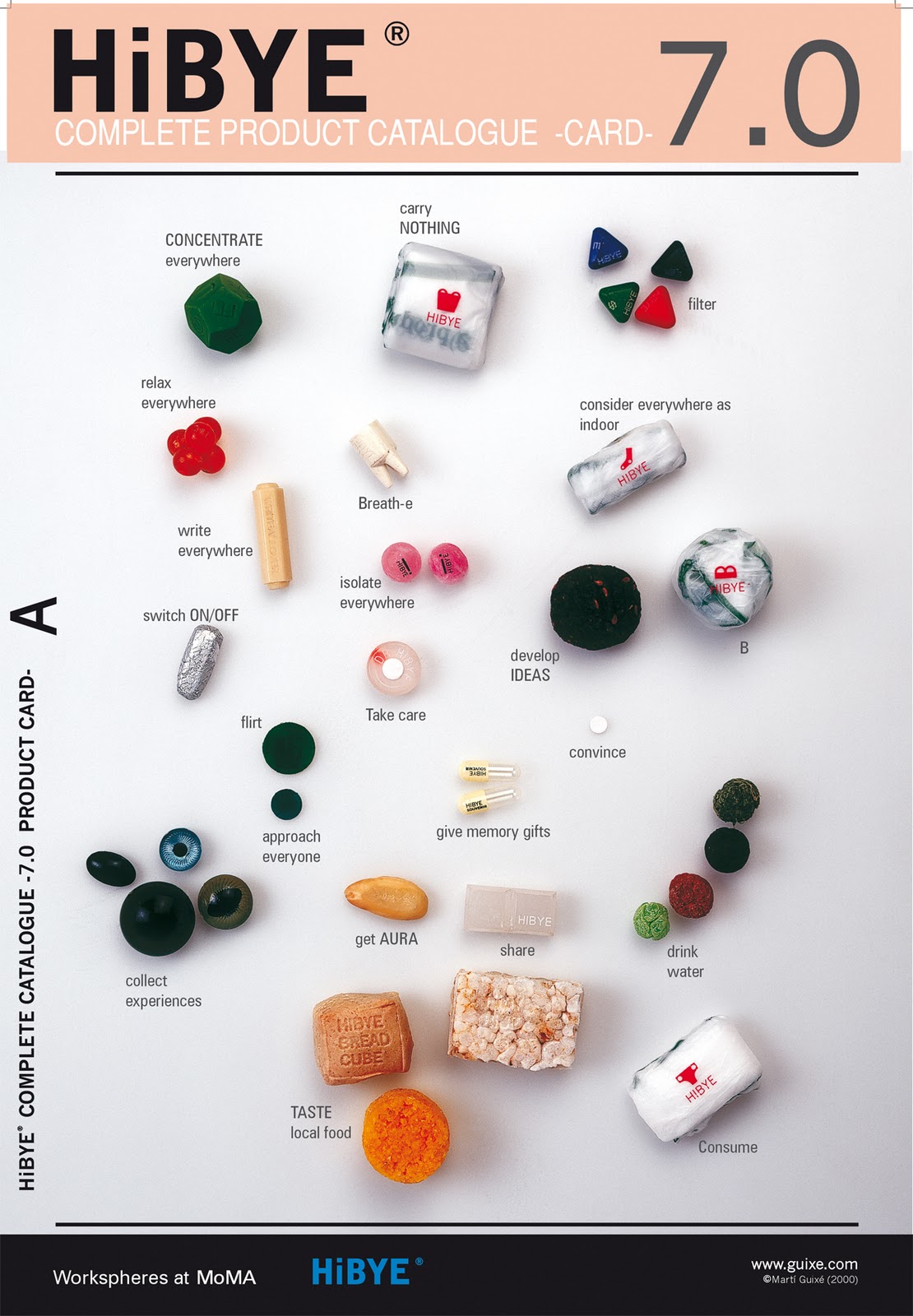
Marti Guixè is a Barcelona-based ex-designer. Ex-designer began in 2001 as a definition of Marti Guixè´s activity in the context of design, emerging as a consequence of the decontextualization attributes to his work. With his project ´ ex-designer` he took on a new status within his own profession, trying to break free of the limits implified by the discipline. 

Marti Guixè is outspoken in his dislikes of design as stylized objects and form. His work claims to alter ways of seeing and thinking and evokes active engagement on the part of the consumer. He has a critical and provocative attitude towards design and therefore his work is sometimes associated with the critical design movement, popularized by Dunne and Raby, but his work seems more playful and less moralistic.


´HIBYE pills´ was a project in 2001, where he provided pills for the worksphere that accomplish the following functions and desired effects: 

1) Consentrate everywhere
2) Carry Nothing
3) Filter
4. Relax everywhere
5) Breathe-e
6) Write Everywhere
7) Switch on/off
8) Flirt
9) Approach everyone
10) Collect experiences
11) Taste local food
12) Get AURA
13) Share
14) Give Memory gifts
15) Take Care
16) Convince
17) Develope ideas
18) Isolate everywhere
19) Consider everywhere as indoor
20) Drink water
21) Consume


Delete

Ji Lee is a designer and creative editor at the Google Creative Lab, who is known for his illustrations and public art projects.

The streets of New York and our outdoor spaces all over the world are cluttered with intrusive and ugly ads, filling each and every empty wall. In 2009 a massive takeover of these billboards was organized and 126 billboards were whitewashed by dozens of volunteers. Over 80 artists transformes the advertising spaces into their personal piece of art. This picture shows Ji Lees contribution.


He has also done a ´Bubble Project´ which consisted of 500, 000 printed stickers that look like speech bubbles used in comic strips. He posted these blank speech bubbles on top of advertisments throughout New York city allowing anyone to write their comments and thoughts.

http://www.youtube.com/watch?v=7emqK4Kb_8g

Thursday, November 11, 2010

Nothing


The New Zealand- based graphic designer Fiona Jack created in 1997 an anti-ad campaign, where she conducted a campaign for a non- existent brand called ´Nothing TM`. The billboards showed slogans like `Nothing TM. What you´ve been looking for´. People even started ringing up asking where they could buy `Nothing`.


In some advertising campaigns the product doesn´t play any role at all. You could easily advertise air as a product.

Ethics, or Aesthetics?


`Our western culture has gone ´aesthetic´. Everything has to be beautiful. In other words it has to have style. The beauty of the exterior suffers no dissonance gladly. Wrinkles are ironed out, muscles are broadened and spots washed away. Everything gleams and glistens.´

Ref. Renny Ramaker, Droog Design in Context

Many designers today are distancing themselves from simply creating beautiful forms and objects. Rather than being inspired by glossy design magazines and glossy materials, they take their inspiration from the anonomous, everyday, meaningless and the natural. 


Tejo Remy´s ´Chest of Drawers´ partly represents a distancing against trendy design. Todays emphasis on the young and new, encourages us to recycle forms, materials and objects. I find it invaluable to base design on what is already there. The reasoning behind this work interests me because I too am interested at looking at reuse of everyday objects. I like the notion of using everyday objects in a variety of new ways, in new contexts, to create different outcomes. Although I am not solely concerned with the use of readymade items, I find it interesting to look at the benefits of secondary use in our ´throw-away´ society.
In the welter of new things we look for recognizability and familiarity.